Beginners
Level every horizon: the one grid you always need
A tilted horizon is the single most common composition mistake in phone photography, and the one grid that fixes it is the simplest one you'll ever use.
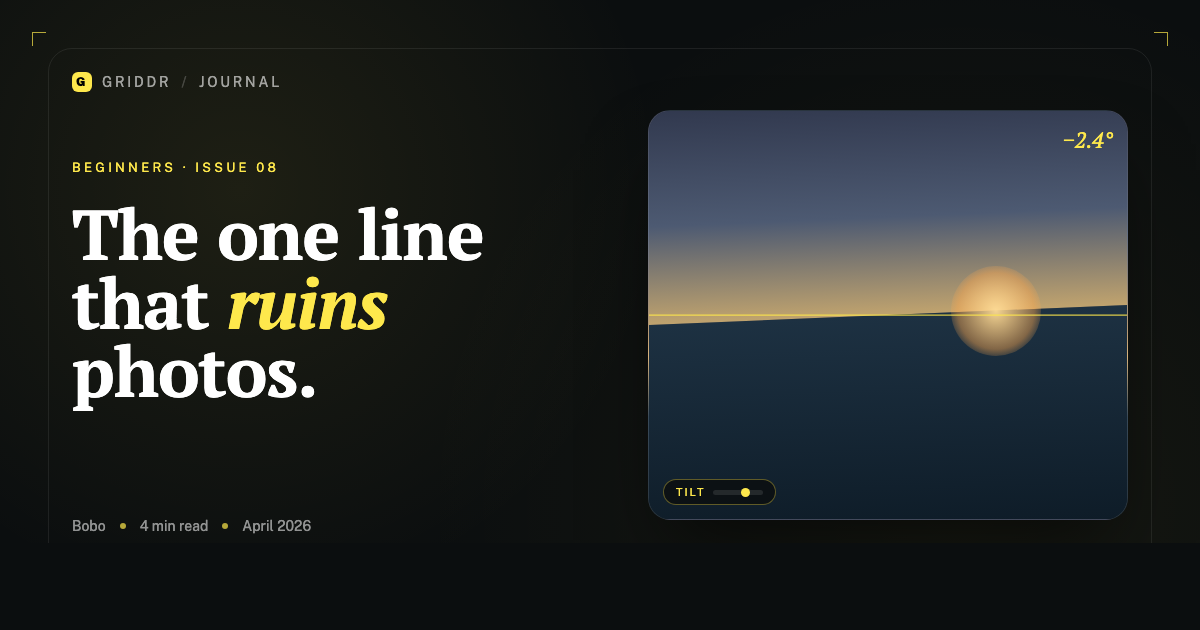
Pull up your camera roll and scroll through the last fifty landscape photos. Count how many have a horizon that's tilted by even half a degree.
If you're like most people, the answer is most of them. Phones are heavier on one side than the other, your hands are asymmetrical, you composed in a hurry, and the horizon ended up running uphill from left to right. The photo is otherwise good. The tilt is the single thing that gives it away as a snapshot.
The fix is one line. Not nine. One.
The horizontal half grid
Griddr ships a grid called the horizontal half — a single horizontal line cutting the frame in half. It's the most-overlooked grid in the menu and the most useful one if you shoot outdoors at all.
You're not using it to put your horizon on the line. You're using it to compare the horizon against the line. Lay the grid line over the frame and tilt the phone until they're parallel. That's it.
Why this works better than a rule-of-thirds overlay: the rule of thirds gives you two horizontal lines, both of which probably don't sit at horizon height. Your eye has to do the work of mentally extending one of those lines to where the horizon actually is. That mental extension is where the half-degree tilt slips in.
The horizontal-half grid sits at the middle, where the horizon often is anyway, and gives you a single unambiguous reference.
One line, parallel. That's the entire technique.
What the in-camera level can't tell you
Phones have a built-in level — a sensor that detects roll. Some camera apps show it on screen. It's useful, but not for what you'd think.
The level tells you the phone is level. It doesn't tell you the horizon is level. Those are different.
If you're shooting a beach with your phone tilted forward to include more sand, the phone is no longer perpendicular to gravity, and the level indicator gets noisy. Or if you're shooting from a hilltop where the horizon is below you, the geometry gets weird. The horizontal-half grid trumps the level in those cases because you're checking the line in the photo, not the position of the device.
Use both. The level for a quick sanity check, the grid for the final visual confirmation.
When you actually want a tilt
Sometimes a tilted horizon is the photograph. A "Dutch angle" — deliberate tilt — is a real compositional choice. It's used in cinema for scenes that should feel destabilized, in skate photography to amplify motion, and in editorial portraits to inject energy.
The trick is that a deliberate tilt has to look deliberate. A 1° tilt looks like a mistake. A 15° tilt looks like a choice. There's no middle ground that reads correctly to a viewer.
Rule: if you're going to tilt, tilt enough that it can't be confused with a sloppy hand. If you're not going to commit, level.
Three places this saves you
Beach and water. A horizon over water shows tilt the most ruthlessly, because water is a perfect horizontal reference. Half a degree off and it looks like the ocean is sliding off the edge of the photo.
Architecture. Buildings have horizontal cornices and vertical walls. A tilted horizon makes a building lean. A leaning building reads as either a snapshot mistake or a special effect — both of which you usually don't want.
Group photos with anything horizontal in the background. A wall, a railing, a tree line, a ceiling beam. Any of these will betray the tilt and make the whole photo feel slightly wrong without the viewer being able to say why.
The 30-second drill
Try this: enable the horizontal-half grid, walk outside, and shoot the same horizon five times. After each shot, look at where the horizon line landed relative to the grid line. By shot three you'll be aligning subconsciously. By shot five you'll wonder how you ever shot without it.
It's a small habit. It also separates the photos that look like you took them from the photos that look like you held a phone up.
There's a reason this is the simplest grid. The simplest grids fix the most common mistakes. Once your horizons are level, the rest of the composition starts to matter — but until they are, nothing else can save the shot.
Related reading
Shoot this with Griddr
Get Griddr — free on iOS & Android